
Beyond the Multiple: Deconstructing Earnings in Unique Economic Times
by Taureau Group
When analyzing and discussing business valuations, a very common starting point is to reference EBITDA multiples, which on the surface is a seemingly straightforward benchmark for comparing companies. While there are a lot of additional factors that need to be taken into consideration that can influence a valuation one way or the other as well as several factors that can distort what was actually paid, a very key question in today’s economic environment is, “a multiple of what?”
With fluctuating earnings and varying levels of uncertainty, the distinction between historical, current, and projected earnings has never been more important. By way of example, a purchase price on the following hypothetical business can be interpreted and underwritten many different ways:
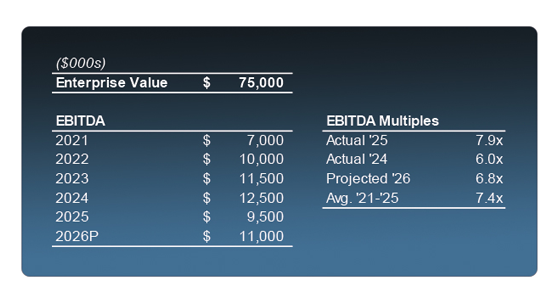
In a stable economy, the last or trailing 12-months (LTM or TTM) EBITDA can often be a reasonable proxy for the future. Over the past year and at the present time, that assumption may not be as reliable. Several major economic and global forces are creating distortions that are making recent financials potentially a more unreliable guide.
Ever since the COVID-19 pandemic, broadly speaking, the demand environment has not been overly consistent. Following the shutdowns, there was pent-up demand that later led to the overbuilding of inventories in select industries, and more recently has been compounded by heightened inflation, tariff uncertainties, and broader supply chain shocks.
Valuation: Be Explicit
In the current environment, simply stating a company is trading at “10x EBITDA” is insufficient and likely misleading. A well thought valuation requires clarity of the baseline figures being underwritten to and all the assumptions being taken into consideration.
- State the Base Case: Always specify whether the multiple is based on TTM, forward-looking, or another figure (e.g., a normalized three-year average).
- Justify the Assumptions: Whatever the base case is, be prepared to defend the underlying assumptions about growth, margins, and cost pass-throughs.
- Stress-Test Key Drivers: Run sensitivity analyses on your most critical assumptions. What happens to the valuation if gross margins only recover by half the projected amount?
- Scrutinize the Comps: Ensure comparable companies and transactions face similar macro pressures. A peer with a domestic supply chain is not a valid comp for a business heavily reliant on imports subject to tariffs.
In conclusion, the EBITDA multiple remains a highly-valuable underwriting and communication tool, but it demands a higher degree of diligence and clarity in the current environment.
To learn more about how Taureau Group can help, contact one of our team members for a complimentary market evaluation of your company or to discuss insights of valuation, a sale process and any other outstanding questions.